
Legora vs Harvey vs Bind: Which AI Legal Tool Fits Your Team?
These tools solve different problems. Legora and Harvey are legal copilots that help lawyers work faster. Bind is contract automation that helps businesses move faster. Understanding this distinction will save you from buying the wrong tool.
The AI legal tech space is growing fast, and confusion is growing with it. Bind, Legora, and Harvey appear on the same "AI legal tools" lists, yet they are fundamentally different products for different users solving different problems.
This is not a typical feature comparison where you pick the tool with the most checkmarks. Legora and Harvey make individual lawyers more productive as AI assistants. Bind makes businesses move faster by automating the contract workflow. Most contracts never need to cross a lawyer's desk. These are different philosophies, not competing features.
Getting this right matters. A law firm that buys Bind expecting a research copilot will be disappointed. An in-house team that buys Legora expecting sales reps to self-serve contracts will be equally frustrated. This guide helps you figure out which approach fits.
The Core Difference
Before diving into features, understand the fundamental philosophy:
| Tool | Primary Purpose | End User | Core Value | Market Focus |
|---|---|---|---|---|
| Legora | Legal copilot | Lawyers | Do legal work faster | Europe (GDPR, EU law) |
| Harvey | Legal copilot | Lawyers | Do legal work faster | US (US case law, litigation) |
| Bind | Contract automation | Business teams + Legal | Remove contracts as a bottleneck | Global (rule-based, any jurisdiction) |
In one sentence:
- Harvey: Helps US-focused lawyers work faster with deep American legal research
- Legora: Helps European lawyers work faster with strong GDPR and EU law capabilities
- Bind: Helps businesses everywhere close deals faster through rule-based contract automation
How Each Tool Works
All three tools use AI, but they apply it to fundamentally different problems. Legora and Harvey are legal copilots: they sit alongside a lawyer and make that lawyer faster at research, review, and analysis. Bind is a contract automation platform: it replaces the need for a lawyer to be involved in routine contract work at all.
The practical difference is who uses the tool day to day. With Legora or Harvey, the end user is always a lawyer. With Bind, the end users are often business teams (sales, HR, procurement) who create, send, and negotiate contracts within guardrails that legal has configured once. Understanding this distinction is key to picking the right tool.
Legora: The Legal Copilot
Legora is a suite of specialized components. Each addresses a different part of the lawyer's workflow. The Chat module handles legal research and ad hoc questions. Tabula is designed for due diligence, helping lawyers analyze multiple documents systematically. The Word Plugin integrates directly into Microsoft Word for reviewing and editing documents.
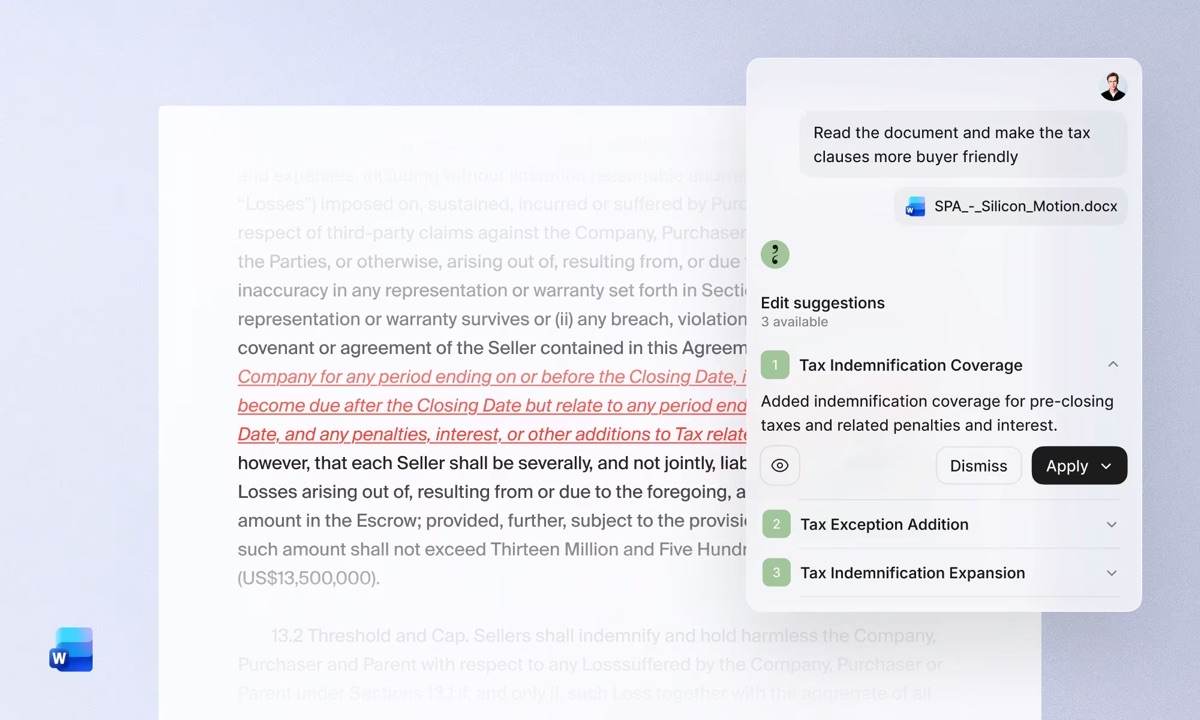
Typical workflow:
- Receive a contract from counterparty
- Open Word, prompt Legora to review from a specific angle
- Legora suggests changes
- Prompt again to refine suggestions
- Accept changes, send back to counterparty
- Repeat for next round (starting fresh each time)
As of our August 2026 review, the interaction is session-based: you prompt, review the suggestions, and drive the next round yourself. Useful prompts can be saved in a prompt library, and Legora offers playbooks for running standardized reviews. The mental model is a legal-trained assistant: you prompt, it responds, you decide what to do. Legora ships quickly, so confirm current capabilities directly with the vendor rather than relying on any published comparison.
Legora has a strong European orientation. It is built with particular depth in GDPR compliance, EU regulatory frameworks, and European local laws. For firms and in-house teams operating across European jurisdictions, Legora understands the nuances of data protection requirements, cross-border EU regulations, and jurisdiction-specific legal language in a way that US-focused tools typically do not. If your practice regularly deals with European data privacy, EU consumer protection, or local compliance requirements in countries like Germany, France, or the Nordics, Legora's training data and capabilities reflect that reality.
Best for: Lawyers working in European jurisdictions who want AI assistance with strong GDPR and EU law capabilities, while maintaining full control over every decision.
In our reading of the copilot model, the payoff lands with the lawyer: the same work, done faster. That is genuinely valuable for individual lawyers and law firms, where throughput per lawyer is the unit of value. But for a business paying those bills, faster-per-task does not automatically translate into the outcome it wants, which is lower legal cost and quicker contract turnaround. This is our analysis of the two models, not a characterisation of how either vendor markets itself.
Harvey: The US-Focused Legal Copilot
Harvey and Legora occupy the same category. Both are legal copilots that augment lawyers through AI-assisted research, review, and analysis. The interaction model is the same: lawyers prompt the AI, receive suggestions, and retain full decision-making authority.
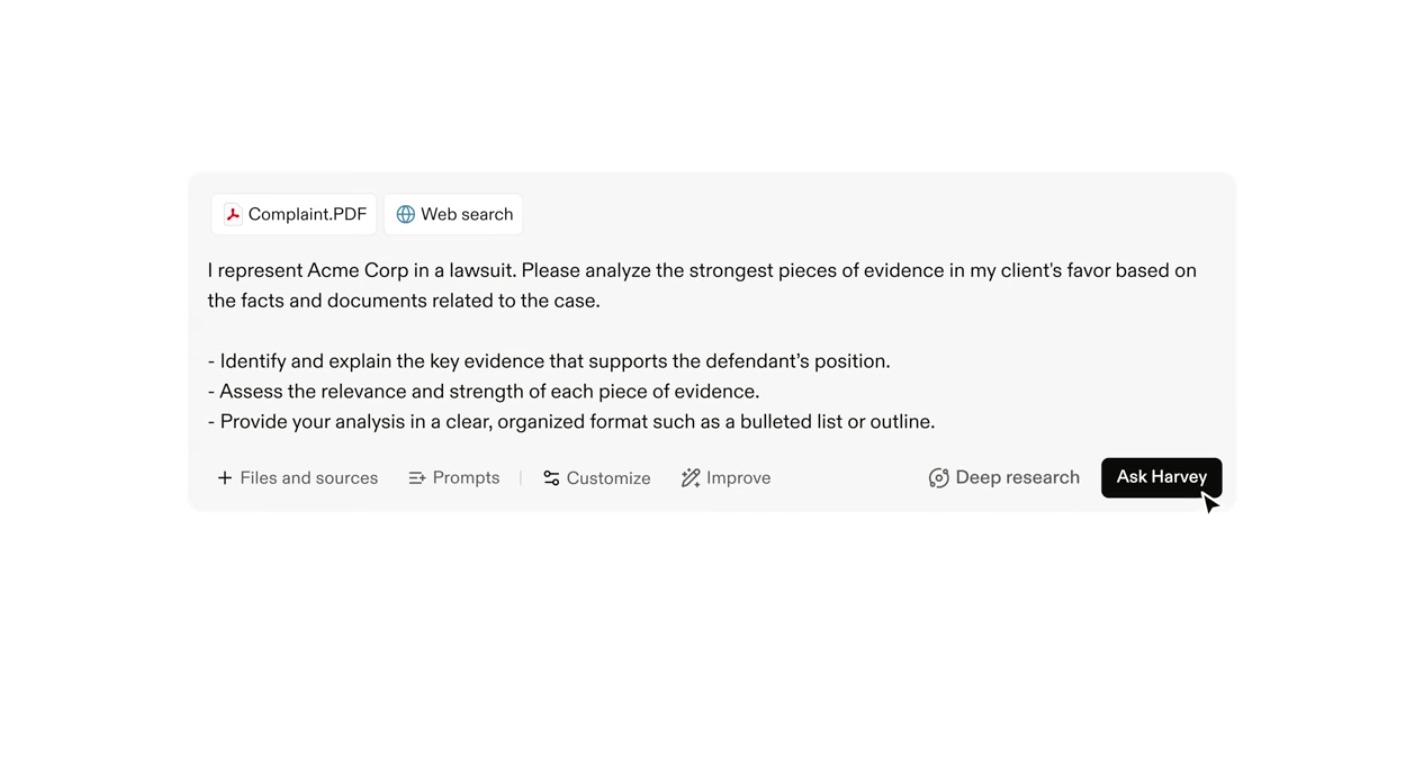
Harvey differentiates through its deep focus on the US legal market. It has extensive integration with US legal databases, American case law repositories, and federal and state regulatory frameworks. Harvey is optimized for American legal workflows, terminology, and the precedent-based system that defines US law. For practices that rely heavily on US case law research, federal regulatory analysis, or state-specific compliance, Harvey surfaces more relevant and precise results than tools built for a broader international audience.
Harvey's strength in the US market also means stronger coverage of litigation support, SEC filings, US patent law, and the specific document conventions used in American legal practice. If your firm operates primarily within the US legal system, Harvey's training data is deeper in this area than competitors with a more European or global orientation.
Typical workflow: The same prompt-based assistance as Legora, with the lawyer remaining in the loop for every decision.
Best for: US law firms and US-focused legal teams wanting AI-assisted legal research and document review, particularly those that handle litigation, regulatory matters, or complex transactional work requiring deep American legal precedent.
Bind: Contract Automation Platform
Bind takes a fundamentally different approach. Rather than a copilot that assists a lawyer, it is a platform built around agentic AI usage rather than traditional workflow software: AI agents handle routine contract work end to end, within rules legal has set, so lawyers focus on the matters that genuinely need their expertise. It is used by lean in-house teams and enterprise legal departments alike.
How it works:
- Set up templates & rules
- Create via AI
- Auto-apply terms
- Negotiate with guardrails
- Route for approval
- E-sign & store
The distinction from Legora and Harvey is critical: Bind is designed for end-to-end contract lifecycle management, not just review of individual documents. Business users (sales reps, HR managers, procurement teams) can self-serve within the guardrails that legal has established, creating and even negotiating contracts without needing a lawyer in the loop for every standard agreement. The automation runs continuously based on your configured rules, rather than requiring prompt-by-prompt interaction. Legal maintains control through the configuration of templates, playbooks, and approval thresholds, not through constant, hands-on involvement in every contract.
It is important to understand what Bind is not. Bind does not do legal research, case law analysis, or jurisdiction-specific legal reasoning. That is what Legora and Harvey are for. Bind's AI is focused on a different problem entirely: ensuring that every contract your organization produces follows the rules, terms, and standards that your legal team has defined. It is rule-based and organization-driven, not case-by-case and jurisdiction-driven. This means Bind works equally well whether your company operates in the US, Europe, Asia, or across multiple jurisdictions, because the rules it enforces are yours, not derived from any particular legal system.
Best for: Companies where contracts are a business bottleneck. Where deals wait for legal review, NDAs take days instead of minutes, and the legal team is drowning in routine requests rather than focusing on strategic work. Slush, one of Europe's largest startup events, manages hundreds of sponsor, venue, and vendor contracts through Bind, a real-world example of how contract automation handles high volume without requiring a lawyer in the loop for every agreement.
See Bind's contract automation in action:

The interactive demo above walks through Bind's six core capabilities:
- Create: Describe what you need in plain language. Bind drafts a complete, compliant contract.
- Review: Every clause is automatically checked against your organization's rules.
- Negotiate: Redlines are handled automatically using your pre-configured playbook. Bind accepts, rejects, or counter-proposes changes without a lawyer reviewing each one.
- E-sign: Built directly into the platform. No switching between tools.
- Manage: A searchable archive of every contract with AI-powered data extraction.
- Chat: Ask questions about any contract in natural language.
- Security: ISO 27001 certified and SOC 2 Type I compliant.
The key difference from Legora and Harvey: these are not suggestions for a lawyer to act on. These are automated workflows that run on rules your legal team has already approved.
The Copilot vs Automation Distinction
Think of it this way. A copilot (Legora/Harvey) is like a very smart research assistant sitting next to a lawyer. The lawyer still drives every decision, but they get there faster. The value is measured in lawyer productivity: more work completed per hour.
Automation (Bind) is a different model entirely. It is a system that handles routine work end-to-end so that experts only get involved when their judgment is genuinely needed. The value is measured in business velocity: deals close faster because contracts are no longer a bottleneck.
- Assists individual lawyers
- Prompt-based, one task at a time
- Value = more work completed per lawyer-hour
- Lawyer in the loop for every decision
- Best for unique, complex matters
- Empowers entire business teams
- Rule-based, runs continuously
- Value = faster deals, fewer bottlenecks
- Humans involved only when needed
- Best for high-volume, repeatable contracts
This distinction matters most when you consider who is paying for the tool and what outcome they need. A law firm benefits directly from a copilot because faster lawyers mean more output per hour billed. But when the buyer is a company, whether relying on outside counsel or an in-house team, the goal is not more productive lawyers. The goal is faster business outcomes with less legal friction. That reframes the entire evaluation.
The question we would put to any legal team evaluating these tools: is your bottleneck the speed at which a lawyer can do legal work, or the number of contracts that have to reach a lawyer at all? A copilot addresses the first. Automation addresses the second. That is our framing, based on how each product is designed to be used.
Where Each Tool Is Strongest
Rather than a feature checklist, here is what each tool genuinely excels at:
Bind excels at the full contract lifecycle
Bind is built for managing contracts from creation to signature to renewal. It includes a template library, clause library, approval workflows, automated routing, built-in e-signatures, and a contract repository. Business users can create and negotiate contracts through conversational AI without needing legal involved in every step. As of our August 2026 review, this end-to-end lifecycle is not what Legora and Harvey are built around - both are designed as copilots for lawyers rather than contract lifecycle platforms. Both ship quickly, so confirm current scope with each vendor.
Legora and Harvey excel at legal research and analysis
Where Legora and Harvey pull ahead is in deep legal work. They integrate with legal databases, support case law search, and are optimized for due diligence across large document sets. Legora's Tabula module is purpose-built for systematic document analysis. Both offer Word plugins that let lawyers review and edit contracts directly in their existing workflow. Bind does not offer legal research capabilities because that is not its purpose.
All three handle contract review, differently
All three tools can review contracts with AI, identify risks, and suggest redlines. The difference is in how that review fits into the bigger picture. With Legora or Harvey, the lawyer prompts the AI and manually applies suggestions. With Bind, review happens within an automated workflow where playbooks define what to flag, what to accept, and when to escalate to a human.
- Deep legal research & case law
- Due diligence across large doc sets
- Word plugin for in-editor review
- Jurisdiction-specific legal reasoning
- Full contract lifecycle management
- Template & clause libraries
- Approval workflows & e-signatures
- Business user self-service
When to Choose Each Tool
Choose Legora or Harvey if:
Legora and Harvey are the right choice when your organization is a law firm that bills for legal services. In this context, the value of AI is measured in lawyer productivity: how many hours of research, review, and analysis can you accelerate without compromising quality? If your work is primarily case-based, where each matter is unique and requires fresh analysis, a copilot model fits naturally because there are no repeatable templates or standard playbooks to automate.
These tools also make sense when the end user is always a trained lawyer who needs AI assistance rather than AI automation. The copilot stays in its lane. It surfaces insights, suggests changes, and answers questions, but every decision flows through the lawyer. If your practice involves legal research capabilities like case law search and regulatory analysis, Legora and Harvey have the database access and training that Bind does not.
Example use cases:
- M&A due diligence across hundreds of documents
- Litigation research and case law analysis
- Complex regulatory analysis for compliance matters
- Bespoke contract drafting for high-value, one-of-a-kind deals
Choose Bind if:
Bind is the right choice when you are an in-house legal team or a business where the primary contract challenge is volume and speed, not legal complexity. If the majority of your contracts are repetitive (NDAs, sales agreements, vendor contracts, offer letters) and follow predictable patterns with known variations, automation delivers far more value than a copilot.
The key question is whether you need business users to create and manage contracts without waiting for legal to be involved in every step. If your sales team, HR department, or procurement group currently sends requests to legal for routine contracts and then waits days for a response, Bind changes that dynamic by letting those teams self-serve within the guardrails legal has established. The result is faster execution for the business and fewer low-value requests clogging the legal team's queue.
Bind is also the right fit when speed of execution matters as much as legal precision. If closing a deal on Friday instead of next Wednesday has real business impact, and the contracts themselves are standard enough that automation can handle them correctly, that is where Bind shines.
Example use cases:
- Sales team generating customer contracts directly from deal parameters
- HR sending offer letters and NDAs without waiting on legal
- Procurement managing vendor agreements at scale
- Standardizing contract terms across the organization to reduce inconsistency
Can You Use Both?
Absolutely, and many companies do. These tools are not mutually exclusive because they address different parts of the legal workflow.
Use Bind for the high-volume, standardizable majority of contracts. Use Legora or Harvey for the complex, one-of-a-kind matters that genuinely need a lawyer's full attention.
For example, a company might route all sales contracts, NDAs, and vendor agreements through Bind's automation platform. Business users create and negotiate these contracts within legal guardrails, and most get signed without a lawyer touching them. Meanwhile, the same company's legal team uses Legora for M&A due diligence, complex partnership agreements, or any matter where the terms are bespoke and require careful, case-by-case analysis. Each tool does what it does best, and neither is asked to do what it was not designed for.
In-House Legal: A Special Case
If you are in-house legal (not a law firm), the choice often favors Bind even for the legal team itself. For more on this topic, see our guide to what is AI contract management. This might seem counterintuitive. Why would lawyers not want a tool designed specifically for lawyers? The answer lies in the fundamental difference between law firm work and in-house work.
In-house legal work is structurally different from what lawyers do at firms. The contracts themselves are repetitive: the same types of agreements, similar negotiation patterns, predictable variations. Success is not measured in billable hours but in business enablement: how quickly can the legal team support the rest of the organization without becoming a bottleneck? And critically, in-house teams need to scale their output without proportionally scaling headcount, which is exactly the problem automation solves.
Legora and Harvey were designed for the case-based, matter-by-matter workflow of law firms where each engagement is unique and requires fresh analysis. In-house legal needs tools that handle the repetitive volume efficiently so that the team's limited bandwidth can be focused on the matters that genuinely require legal judgment.
The framing we hear most often from in-house counsel in our own demo calls: the goal is not to review every NDA personally, but to have a system that handles NDAs correctly so the team's attention goes to the deals that genuinely need it.
Pricing Comparison
| Tool | Pricing Model | Starting Price |
|---|---|---|
| Bind | Per seat / flat team | $90/seat/month (Starter), $500/month (Business, incl. 5 users) |
| Legora | Per user | Contact for pricing (no published rates) |
| Harvey | Enterprise | Contact for pricing (no published rates) |
Bind's pricing is published. Legora and Harvey publish neither rates nor seat minimums; any figures you find for them come from customer reports and legal-technology publications, not the vendors.
The pricing transparency here reflects the different go-to-market approaches. Legora and Harvey require sales conversations and enterprise agreements before sharing pricing details, which is standard for tools targeting law firms and large legal departments. Neither publishes a rate or a seat minimum, and no independent purchasing dataset covers either of them, so any figure you find for them online is secondhand: the only number that will apply to you is the one on your quote. Bind, by contrast, publishes its pricing openly and offers self-service signup, with no implementation fees or mandatory professional services on top of the subscription.
Making the Decision
Ask yourself these questions:
Who will use this tool daily? If the answer is exclusively lawyers (people with legal training who are comfortable with prompts and legal analysis) then Legora or Harvey fits naturally. If the tool needs to serve business users (sales, HR, procurement) alongside legal, Bind is the right choice because it is designed for non-lawyers to use within the guardrails legal sets.
What type of work dominates? If your team spends most of its time on unique, complex matters where each engagement requires fresh analysis and bespoke drafting, Legora or Harvey will augment that work effectively. If the majority of your workload is repetitive, standardizable contracts that follow predictable patterns, Bind automates those workflows at a level that a copilot cannot match.
What does success look like? If the goal is helping your lawyers work faster on the same types of matters they handle today, a copilot delivers that productivity gain. If the goal is helping your business move faster by removing contracts as a bottleneck so that deals close sooner, hires onboard faster, and vendor agreements do not sit in queues, automation is the right lever to pull.
How do you want AI to help? If you want AI to assist your decisions while you remain in the driver's seat for every contract, Legora or Harvey provides that assisted workflow. If you want AI to handle routine work automatically so that humans focus only on the exceptions that truly need judgment, Bind delivers that level of automation.
The Bottom Line
Legora and Harvey are legal copilots. They make individual lawyers more productive by providing AI assistance for research, review, and analysis. The lawyer remains in the loop for every decision, and the AI's value is measured in how much faster that lawyer can complete their work.
Bind is contract automation. It handles routine contract work from end to end so that legal teams can focus on high-value matters and the rest of the business can move forward without waiting in a queue for legal review.
Neither is "better" in absolute terms. They solve genuinely different problems, and many organizations use both. The right choice depends on whether your primary challenge is lawyer productivity (copilot) or business velocity (automation).
If contracts are slowing down your business, if your legal team is spending too much time on routine agreements, and if you need to scale your contract output without proportionally scaling headcount, Bind is likely the right choice. It turns contract management from a bottleneck into a streamlined, largely automated process.
If you are a law firm, or if your team primarily handles complex, one-of-a-kind legal matters that require fresh analysis and bespoke drafting, Legora or Harvey provides the AI assistance that makes that work faster and more thorough.
Bind's CEO Explains the Automation Approach
Curious how Bind's contract automation differs from the copilot model? Aku Pöllänen, Bind's CEO, explains the thinking behind Bind's end-to-end approach:
Quick Summary
| Legora | Harvey | Bind | |
|---|---|---|---|
| What it is | Legal copilot | Legal copilot | Contract automation platform |
| Built for | Lawyers | Lawyers | Business teams + Legal |
| Core job | Make lawyers faster | Make lawyers faster | Make contracts faster |
| How AI works | Prompt-based, one task at a time | Prompt-based, one task at a time | Rule-based, runs continuously |
| Market | Europe (GDPR, EU law) | US (case law, litigation) | Global (any jurisdiction) |
| Covers full contract lifecycle | Not a focus | Not a focus | Yes (create, review, negotiate, sign, manage) |
| Business users can self-serve | Not a focus | Not a focus | Yes |
| Legal research & case law | Yes | Yes | Not a focus |
| Pricing | Contact sales (no published rates) | Contact sales (no published rates) | From $90/seat/month (published) |
| Best for | EU-focused law firms & legal teams | US-focused law firms & legal teams | Companies where contracts are a bottleneck |
(Based on vendor-published materials as of August 2026. Legal AI moves quickly - "Not a focus" means the product is not built around that job, not that the capability is permanently absent; confirm current scope with the vendor.)
Three different tools, three different problems. If your lawyers need to work faster, Legora or Harvey is the right pick depending on your geography. If your business needs contracts to move faster, Bind removes that bottleneck entirely. Many organizations end up using both: automation for the routine majority of contracts, and a copilot for the handful that genuinely need a lawyer's full attention.
Ready to simplify your contracts?
See how Bind helps teams manage contracts from draft to signature in one platform.
Bind is trusted by legal teams across Europe and the US